Monday, October 20, 2008

OMG, ur so kewl!


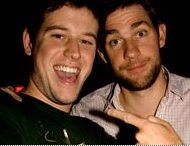
Ben: Dude, it's me and Harry Potter!

Daniel: Who the f#$! is this dork?

Why stop Ben Lyons?

July 21st 2008, a day to live in infamy. We have been subjected to so much nonsense since then, especially out of the mouth of Ben Lyons.

I did not expect much from the post-Ebert At The Movies--I could not help but think that the "new direction" the show was going would not be a good one, especially after hearing something about more red carpet interviews. But as a long time viewer, I had little choice in the matter.

I have not been eager to watch At The Movies since then, only catching bits of it on occasion because that is what I am so used to doing on Sunday night at 6:30pm. I was immediately unimpressed and not eager to watch again.

But this past Sunday I turned it on out of habit and realized that the situation is just no longer tenable. Not only do I need a more serious film review show on TV, but more importantly BEN LYONS NEEDS TO BE STOPPED! He is making a mockery of one of the hallowed institutions of popular American film-going.

In particular, two reviews stuck out. First, on the new movie What Just Happened starring De Niro as a Hollywood agent, Ben goes so far as to say that he liked it because he is a Hollywood insider but he cannot recommend it to most people who might not understand it. This is preposterous, offensive nonsense. The role of the critic, as Roger Ebert once wrote, is not only to reflect popular opinion but also to shape it. If a critic enjoys a movie, they should say why and defend it. If the majority of the audience might not follow it, it is the job of the critic to urge them to view more movies (or literature or theatre or whatever) not to dumb down their recommendations to the lowest common denominator. Ben even says that it "Doesn't have the commercial appeal of something like Entourage. It's a little more adult than that."

Gee Ben, are you just trying to tap into the commercial appeal of a movie and ride its coattails, or are you willing to say why a movie which might not have commercial appeal--starring De Niro, Sean Penn, and Bruce Willis!--is worth seeing. Granted, I am sure it is no I Am Legend . I guess this is Buena Vista Entertainment's method of appealing to young people--dumb it down. Oh, and by the way Ben, you are NOT that much smarter than the rest of us. Not by a long shot.

In another review of The Secret Life of Bees, Ben seems to have no grasp of what makes a movie worth seeing. He defends it by saying it is about acceptance, understanding, etc. then accuses his co-star of not understanding or caring about these issues because he did not like it! Again, his co-star says there is no compelling reason to see this film, to which Ben (Lyons) responds that seeing a young actress (Dakota Fanning) at this stage in her career is reason enough.

What?! I am not defending or slamming the movie--I have not seen it. But this is not film criticism--this is talking about a film. But, to cite Ebert again, a movie is not what it's about, it is how it's about it. Ben's reviews, on the other hand, wallow in third grade book report territory. We need a seasoned mind with a firm grasp of how a film works and an ability to help others appreciate it.

This needs to stop NOW. Buena Vista Entertainment made a huge mistake in taking the show in a "new direction". By the way, I started watching this show in high school, when it was Siskel & Ebert, and I never thought twice about the age of the guys I was watching. I loved it because they, like me, loved movies and new a hell of a lot about them--much more than I did.

It is time to bring that back.

What is the greatest movie ever made?

Citizen Kane, of course. "That's the official answer," according to Roger Ebert, in a very thoughtful article on what is a great movie and what is a critic's favorite movie.

Our Ben is no prisoner to fashion, though, as evidenced by the poster for I Am Legend, shown below. That is Ben's blurb at the top:


I cannot help but wonder at what point some ad exec will find this to be just a bit too hyperbolic and unbelievable. There comes a point when people see through this sort of nonsense and won't believe anything on the poster. Unfortunately, fawning and self-congratulations will get you very far in Hollywood.

Ben's resume

This is the guy who replaced Roger Ebert on "At The Movies". Seriously.

Born and raised in New York City, after checking out a few semesters at The University Of Michigan (Go Blue!), and working in the music business in NYC, I bounced to LA and changed my life forever. I'll always love my New York Knicks, Post, subways, bagels, Central Park, street vendors from Senegal, you name it. All that. Shout out to my family, Lil' Hannah, The Power Pack, Dylan McKay, Redman, Chris Childs, Ricky Slade, Momager, Elton Brand, Big Ian Ziering, Coach Voelkel, Diddy, Iqball up in Blimpie's, Rocky from Cavs, The Clipse, Mobb Deep, Al Gore and anybody else out there making a difference and making it rain at the same time. Holla at me day or night, lyonsden@eonline.com. Come hang out next time you are in Las Vegas. I do it big at SMASHTIME Saturdays at The Hard Rock Hotel with me, Clinton Sparks, and Big Brother Sal Masekela. Get Familiar with The Daily Ten!!! You don't see Access Hollywood in the club, right? Go Knicks... BL

Also, according to his Wikipedia page: Lyons plays basketball and golf and deejays every week at L.A. social venues the Dime and the Roosevelt Hotel.

Couldn't they have just walked into another club and found another DJ? Aren't these guys a dime-a-dozen in L.A.? Oh yeah, I forgot his most important qualification.

Sunday, October 19, 2008

My God, it's full of stars!

Ben Lyons, poser with famous people.

I have to admit, I don't know who many of these people are. And I think calling fellow E! hosts "stars" is a bit of a stretch.

Wednesday, October 15, 2008

Turning ordinary people into punch lines


THE BEST documentary films seek out fascinating subjects unfamiliar to the audience whose stories allow us to take a fresh look at the world. Comedian Bill Maher, star of the film Religulous, certainly seems to think he has found such a subject--himself.

In fact, the entire film plays like a stand-up comedy act where the people he is interviewing are just as often the punch lines as Maher's condescending comments. The result is a film that does little to illuminate religion in modern life and politics and is often downright reactionary.

The fundamental problem with Religulous is that Maher's focus is on interviewing religious people in order to expose how stupid they are--especially compared to such a clever interviewer as himself--while he never attempts to take a deeper look at the social circumstances behind religious ideas and institutions.

At least three of his interviewees express exasperation on camera that they felt ambushed by his film and didn't realize that his line of questioning would be so harsh toward their beliefs. In the meantime, Maher throws out a series of pre-rehearsed zingers to ridicule his unsuspecting subjects.

Presumably, Maher, an opponent of George W. Bush and the Iraq war, sees himself as an anti-religious Michael Moore. But while Moore has his own brand of smugness, he is much better at finding interesting subjects who can speak for themselves. Moore also has respect for working-class people and avoids ridiculing their opinions when they are working through their contradictions.

There is a world of difference between Moore's ambush of gun-nut Charlton Heston--who certainly had a little idea of what he was getting himself into when he agreed to be interviewed for Bowling for Columbine--and Maher's accosting of Christian truck drivers in their makeshift chapel. That is, while Moore attempts to show the stupidity of the powers-that-be, Maher is focused on showing the stupidity of the little guy.

- - - - - - - - - - - - - - - -

MAHER IS not only condescending, he is also a hypocrite. Even though he is an agnostic who is opposed to institutional religion, he is also a Zionist. This may be one of the reasons why he doesn't investigate the political views of evangelical Christians more closely, as they would agree with him on the need to defend Israel, and focuses on ridiculing their theology instead.

Furthermore, Maher never questions the lunatic fantasies of Orthodox Jewish Zionists in Israel and their often violent, racist and theocratic attitudes. Instead, he interviews a Jewish rabbi wearing a Palestinian flag pin who is an anti-Zionist--as though he is the crazy one!

The film dishonestly edits one of his responses to make him appear dismissive of the Holocaust and plays up his associations with Iranian President Mahmoud Ahmadinejad. Though the rabbi refuses to be caricatured, his views aren't investigated much further, as Maher storms out of the interview after he is himself exasperated. Apparently, Maher was even less prepared for this interview than the Christian truckers he ambushed earlier.

This line of thinking is brought to its logical conclusion toward the end of the film with a discussion of Islam. While most religions are made to appear merely stupid, Islam is presented as inherently violent and dangerous, in particular by a representative of the World Court at The Hague, who explicitly says, "Islam is a violent religion."

In discussing criticisms of religions versus violent responses in defense of them, Maher asserts, "The people who do the killing usually wind up on the Muslim side," conveniently forgetting all of the Muslims who have found themselves victims of U.S. and Israeli policies. And when a Muslim woman he tells this to insists that not all Muslims are violent, the film cuts to Maher telling the camera that he thinks Muslims only say this sort of thing in public but in private they know there is something wrong with their religion.

He goes on to question Muslims about violent passages in the Koran and even refers to it as an imperialist religion that at one point ruled a large part of the world! Even more shocking, in a discussion of the "Islamic threat" to Israel, the film points out that there are 1 billion Muslims in the world but only 14 million Jews. One might be forgiven for concluding, after hearing Maher, that the Holocaust was perpetrated by the Islamic Middle East and not the "enlightened" Christian West.

If "religulous" ideas are an irrational belief in improvable supernatural phenomena, then Bill Maher's views should be identified as "areligulous"--irrationally opposed to religion, Islam in particular. Had he taken a moment to investigate his own prejudices, he might realize that he is spouting the same sort of offensive nonsense about Islam as Jewish Zionists and evangelical Christians.

Instead, Maher makes the same mistake as the militant atheist Christopher Hitchens--by demonizing the "enemy religion," he makes the reactionary forces among the dominant religion all that much stronger.

Several documentaries have been released in recent years with an interesting take on religion, including Hell House, Devil's Playground and Jesus Camp. All of these take a critical look at religion in the lives of young people but also allow the subjects to speak for themselves.

This does not keep the filmmakers from clearly criticizing what we are seeing, but in the end we get a much more nuanced and interesting picture of the people behind the ideas. We are allowed to sympathize with the individuals in the movies but we are also given an honest look at both the attraction and the torment behind religious beliefs.

Religulous does none of these things. Ultimately, it is a vanity project by a comedian who provides a shallow commentary that is more condescending than funny and more effective at justifying the status quo than challenging it.

W(hat, he worry?)


Oliver Stone's "W." doesn't probe as deep into the psyche of his subject as his "Nixon" does, but Stone makes the case--convincingly--that there is not much depth to probe.

Granted, there are some cartoonish elements, in particular the portrayal of Condoleeza Rice and a few obligatory scenes that don't add much to the film--the famed pretzel incident, for example. In a sense, it threatens to devolve into a "lowlights" of the Bush presidency, where every "misunderestimated" sentence spoken by the President is given a chance to air. Josh Brolin's protrayal, though, is spot-on. Sure it is a bit of a caricature, but what exactly have we seen over the last 8 years? Brolin takes Bush's voice and mannerisms and gives us a new look at him behind the cameras--a bit buffoonish, but just enough so to make him believable AND ridiculously funny.

But "W." is at its best where it really should be at its worst--lengthy staff meetings in the White House with the cabinet discussing war strategy. This ought to fail miserably, but instead these scenes are a fascinating portrayal of the various tensions and opinions that played out in the lead up to the invasion of Iraq. In moments like these Bush seems completely out of his element--not a simpleton too stupid understand the issues, but a simple man with a very simplistic view of the world. When it all unravels, he just cannot understand why people don't appreciate him more.

There is little political context to the events that play out, although this is a part of the lead character's narrow world view. For example, there is almost no discussion of the Democrats role in the Iraq War, although we do get a scene of all the major Dem's--Clinton, Kerry, Dodd, Biden, and Kennedy--applauding Bush's State of the Union preceding the 2003 invasion. Junior's relationship with his Dad is similarly overplayed a bit in terms of understanding the man, though it is portrayed well with James Cromwell as "H.W.".

Finally, it must have been hard to write an ending, considering the timing of the release, but the one that was chosen was especially confusing and dissatisfying. Nonetheless, "W." maneuvers its way around a number of even larger pitfalls to make it well worth seeing.